

Prices for scanning slides

You pay:
a price per slide + postage for return of your slides
1) Prices for Scanning
a) 35mm, (the commonest size, also known as 135 format), half frame format and 126 format
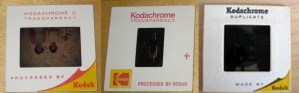
|
The overall size of the mount is 2 inches square in all three. The film areas are: 135 format - 36mm x 24mm, Half frame - 24mm x 18mm. 126 format - 26.5mm x 26.5mm. |
Basic price list for the standard JPEG files:
- number of slides
- 1 - 100
- 101 - 500
- 501 - 1000 (max)
- price per slide
- 50p
- 45p
- 40p
The minimum order charge for scanning is £20, postage added on top of this.
The table of prices above is intended to mean that the first 100 slides are always charged at 50p, subsequent slides are charged at 45p up to 500, etc.
If you wish to have the TIFF files as well as the JPEG files add 20p per slide. If you wish to have the TIFF files instead of the JPEG files add 10p per slide.Why would I want the TIFF files? See section 3 on this page.
Any extra copies of the disk will be £2 each.
b) 127 format
 The overall size of the mount is 2 inches square and the film area is 40mm x 40mm.
Basic price list for the standard JPEG files:
- number of slides
- 1 - 100
- 101 - 500
- 501 - 1000 (max)
- price per slide
- 100p
- 90p
- 80p
The minimum order charge for scanning is £20, postage added on top of this.
The table of prices above is intended to mean that the first 100 slides are always charged at 100p, subsequent slides are charged at 90p up to 500, etc.
- number of slides
- 1 - 100
- 101 - 500
- 501 - 1000 (max)
- price per slide
- 100p
- 90p
- 80p
The minimum order charge for scanning is £20, postage added on top of this.
The table of prices above is intended to mean that the first 100 slides are always charged at 100p, subsequent slides are charged at 90p up to 500, etc.
If you wish to have the TIFF files as well as the JPEG files add 20p per slide. If you wish to have the TIFF files instead of the JPEG files add 10p per slide.Why would I want the TIFF files? See 3 on this page.
Any extra copies of the disk will be £2 each.
c) Larger slides
Please email if you have larger sizes.
Examples of commoner medium format sizes would be:
2 1/4in x 2 1/4in: £1.50 per slide
3 1/4in x 2 1/4in: £1.80 per slide
Captions
Add 5p per slide if you want embedded captions.
You may have captions for all or most of your slides and these can be incorporated into the jpg file. These captions are not going to be visibly stamped onto the image but there are ways of seeing them when you need to.
You would have to supply a list in a text file of the slide numbers and the captions.
Note: This is offered only for ALL your slides, not a selection of them and can only work if all your slides are individually numbered as described in the Details page. Also see the Details page for more information on captions.
Postage and Packing
The principle is that the customer pays whatever it costs to return his or her slides with any boxes/slide-holders and it will normally be the same as what the customer paid to send them to me. This amount will be added to the invoice.
I just charge the postage rate, not for packing. I don't buy much new packaging: I will usually reuse the same packaging the customer used to send the slides to me.
Collection in person will of course save the return postage and packing. If you live locally you are very welcome to deliver and collect rather than use the post. Please make a proper arrangement with me first.
2) What's included in the price
The basic premise is that I will scan the slides in exactly the same way (and with the same care and attention to detail) as I have scanned my own slide collection.
Every slide is dealt with separately. The price includes:- checking slide for suitability (no loose bits)
- careful brushing
- scanning using a state-of-the-art professional film scanner at 2000 dots per inch which will yield JPEG files of around 800kb on average and TIFF files of 14MB.
- inspecting the result and if necessary:
- applying any scanning technology that may be able to improve the image. This includes using infra-red scanning technology (ICE4) to reduce incidence of ingrained dust and other blemishes. Also rescanning using multi-sampling and/or multi-exposure.
- removing red-eye
- removing pet-eye (yes really, usually dogs)
- applying post-scan processing to improve the image. This is sometimes not necessary but if it is, it is carried out with very great care. Note however that this is not a restoration service; I would not spend more than 2 or 3 minutes on each image. It may include altering the colour balance, the white balance, etc. I will also attempt to remove any blemishes that Digital Ice has not removed. If however a slide has a lot of blemishes that are too large for removal with Digital Ice I would not embark on a full restoration - I would only remove the most prominent ones if possible.
- copying the images onto a data-CD or data-DVD as JPEG files or TIFF files.
- designing a label, printing and attaching it to the disk.
- the photos are supplied on disk(s) in a tranparent plastic sleeve.
- dispatching the disk along with your slides back to you.
3) Why would I want the TIFF files?
The TIFF files are large, around 14MB, but they contain all the information from the scan. The JPEG format is an extremely clever means of reducing the filesize to a manageable 0.75 MB by snipping away lots of bits of information that you hopefully won't notice. If you are only going to look at the photos on your screen or print them, then the JPEGs will be fine. But every time you open, edit and save a JPEG file, even if you ask for "100% quality", you introduce degradation to the image. So if you want to manipulate the image further you should use TIFF files. TIFF files are 'lossless', JPEG files are 'lossy'. When I did the original scanning, I worked on the TIFF files and only saved once to JPEG as the final operation.
top
